
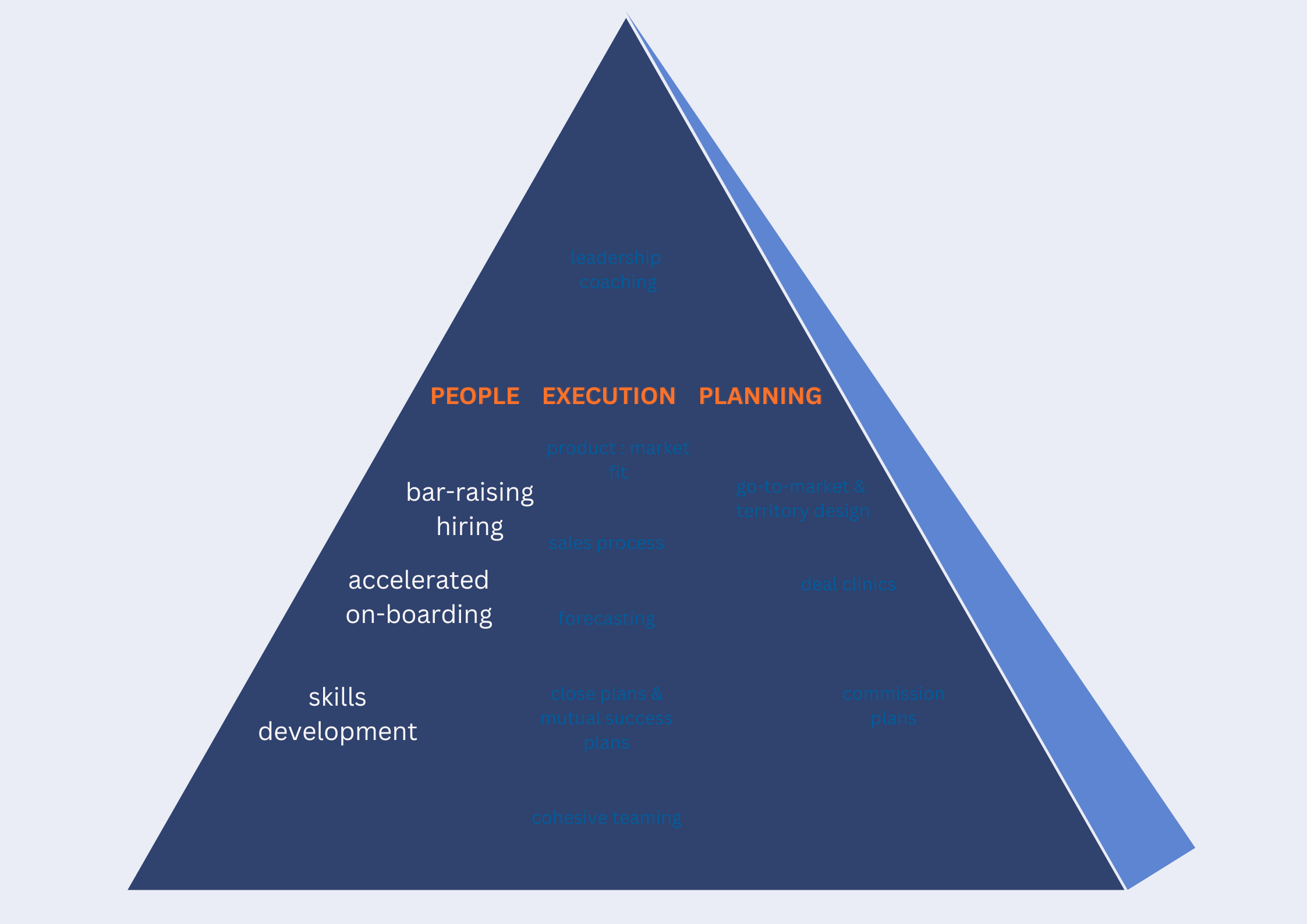
the PEOPLE domain
Accelerated onboarding
Problem
New hires are left to 'pick things up' by talking to people around them.
Weeks pass before you realise they’re not ramping up as fast as expected.
Solution
Structured onboarding programs with measurable progress tracking.
Founders gain confidence early that new hires are on track, gaps are identified fast, and the team sees this is an organisation that takes development seriously.
Early structure in onboarding prevents costly drift and sets the tone for a high-performance culture.
Bar-raising hiring
Problem
Costly mis-hires set the business back months and drain limited runway.
Decisions made on gut-feel and urgency, not process.
Solution
A proven hiring process for customer-facing roles. Specifically critical early sales role.
Includes scorecards, structured interviews, and attribute-based assessment. Built from years of scaling at MuleSoft, Informatica, and tech scale-ups since.
Avoids expensive mis-hires.
Don’t hire for logos on a CV. Hire for attributes that fit a scale-up.
Skills development
Problem
Assumptions new hires will 'self-correct' or learn by osmosis, but performance never lifts.
Responsibility for feedback often lies with the founder / leader - who, whilst impressively entrepreneurial, isn’t trained to coach professional sales skills.
Solution
Coaching is specific, practical, and based on proven methods - not theory or books.
Leaders get confidence that their team is learning the right skills, the right way.
Professional skills aren’t learnt from books, but from practice, feedback, and coaching.
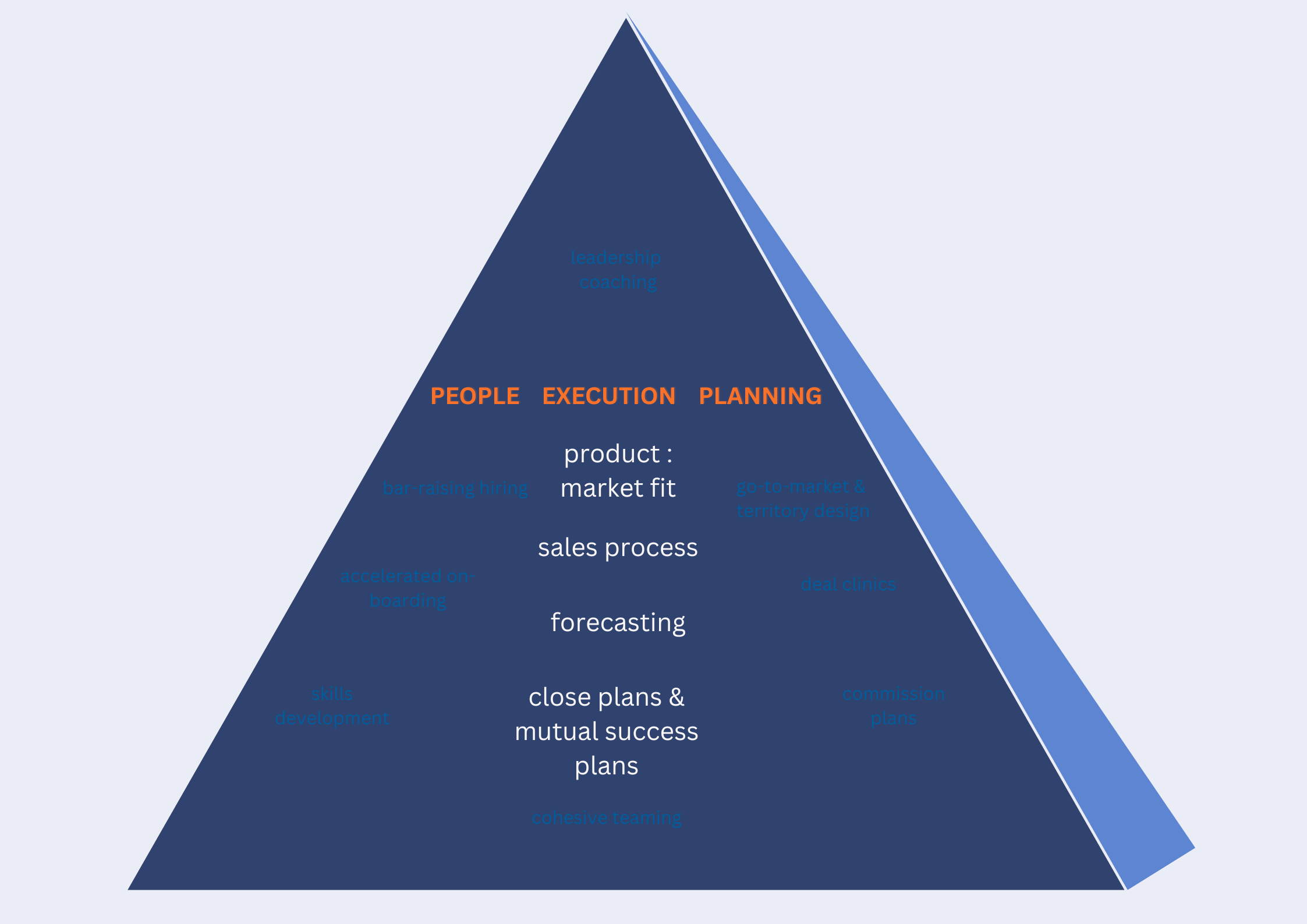
Product : market fit
Problem
Constantly customising to win each deal → nothing is repeatable.
Silent drain of cash.
Solution
Position the roadmap: sell the future vision without overpromising.
Ground the roadmap in real customer problems - not internal feature ideas.
Train sales to confidently sell today’s product, while framing upcoming features as a bonus.
Momentum comes not from waiting for perfect, but from selling confidently what’s ready now.
Forecasting
Problem
Forecasts driven by intuition, optimism, or deal age rather than verifiable customer behaviour.
Quarter after quarter, forecasts are missed. The business simply can’t rely on the projections and confidence is lost.
Solution
Anchor forecasting to observable, customer-validated actions, not internal activity.
Align forecast stages directly to the sales process and mutual success plan milestones, creating consistency across execution and reporting.
Treat forecast accuracy as a capability, not a hope.
Predictable forecasting unlocks confident decisions. And confident decisions enable scale.
Sales process
Problem
Sales processes built entirely around internal steps such as meet → demo → proposal → close, with little connection to how customers actually make decisions
Teams relying on effort and activity, rather than disciplined decision criteria, to move deals forward.
Solution
Establish a clear, best-practice sales process. Define objective stage criteria so opportunities only move forward when the customer has taken a meaningful action.
The result: a sales process that is repeatable, coachable, and trusted - by sales leaders, by executives, and by the team.
the EXECUTION domain
Economic control
Problem
Revenue grows, but the economics remain unclear.
Leaders lack a clear understanding of how revenue growth, pricing, and cost structure translate into profitability.
Without economic discipline, businesses can scale activity while quietly eroding margins.
Solution
Use proven financial discipline to understand how revenue growth, pricing, and cost structure interact to create sustainable profitability.
Define the revenue required for the business to be economically viable and make decisions anchored in those realities.
Financial discipline builds confidence - for customers, employees, partners, and investors.
Mutual success plans
(Close plan is a well-known term, but Mutual success plan is so much more effective).
Problem
Opportunities that appear healthy but quietly stall because no one is clear on what actually needs to happen next.
Customers unsure how to navigate their own internal steps.
Deals slip - quarter after quarter.
Solution
Replace seller-centric close plans with mutual success plans. A shared view of how the customer achieves their desired outcome. Start with the customer’s end goal, then work backwards to define the critical milestones required to achieve it.
Expectations are clear. Risks are managed. The best way to ensure deal execution is on track.
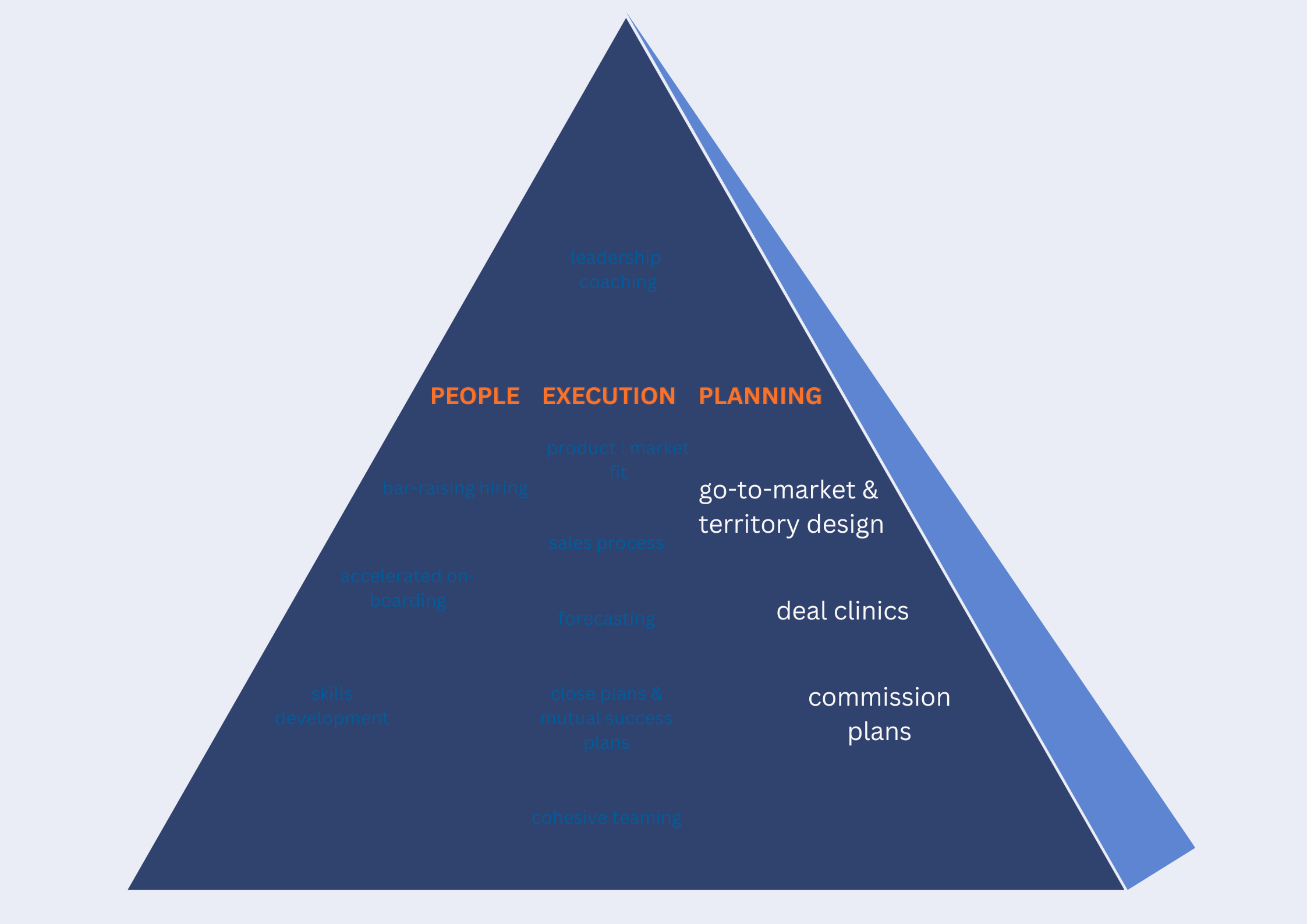
the PLANNING domain
Go-to-market & territory plans
Problem
Lack of clarity on how to align your most valuable resources for the best return.
Misuse of partners: no clear rules on when to sell through a channel, when to co-sell, and how to define channel-specific territories.
Solution
Ensure alignment with the corporate objectives, so resource allocation supports the strategy, not just local targets.
Deploy supporting roles (inside sales, SDRs, telesales, AI tools) in a way that feeds pipeline and maximises ROI on scarce resources.
Effective GTM aligns people, partners, & resources to drive the company’s biggest objectives.
Deal clinics
Problem
You discover late that a transaction you banked on was never truly qualified.
Critical sales revenue is delayed because issues aren’t surfaced or addressed early.
Solution
Run structured deal clinics to review live opportunities and stress-test the strategy.
Your people learn in real-time through coaching and peer-led discussion.
Issues are exposed early, preventing wasted cycles and improving win rates.
Deal clinics turn every live opportunity into a learning moment and a step towards higher win rates.
Commission plans
Problem
Incentives reward the wrong behaviour.
Poorly constructed plans consume disproportionate time and energy. Directs focus internally, rather than externally towards the market.
Solution
Ensure incentives are congruent with the organisation’s business objectives.
Apply proven compensation frameworks drawn from years of experience scaling sales teams.
Follow a few simple principles that, once mastered, deliver sustainable motivation and performance.
The right plan doesn’t just reward fairly - it channels energy into the outcomes that matter most for the business.
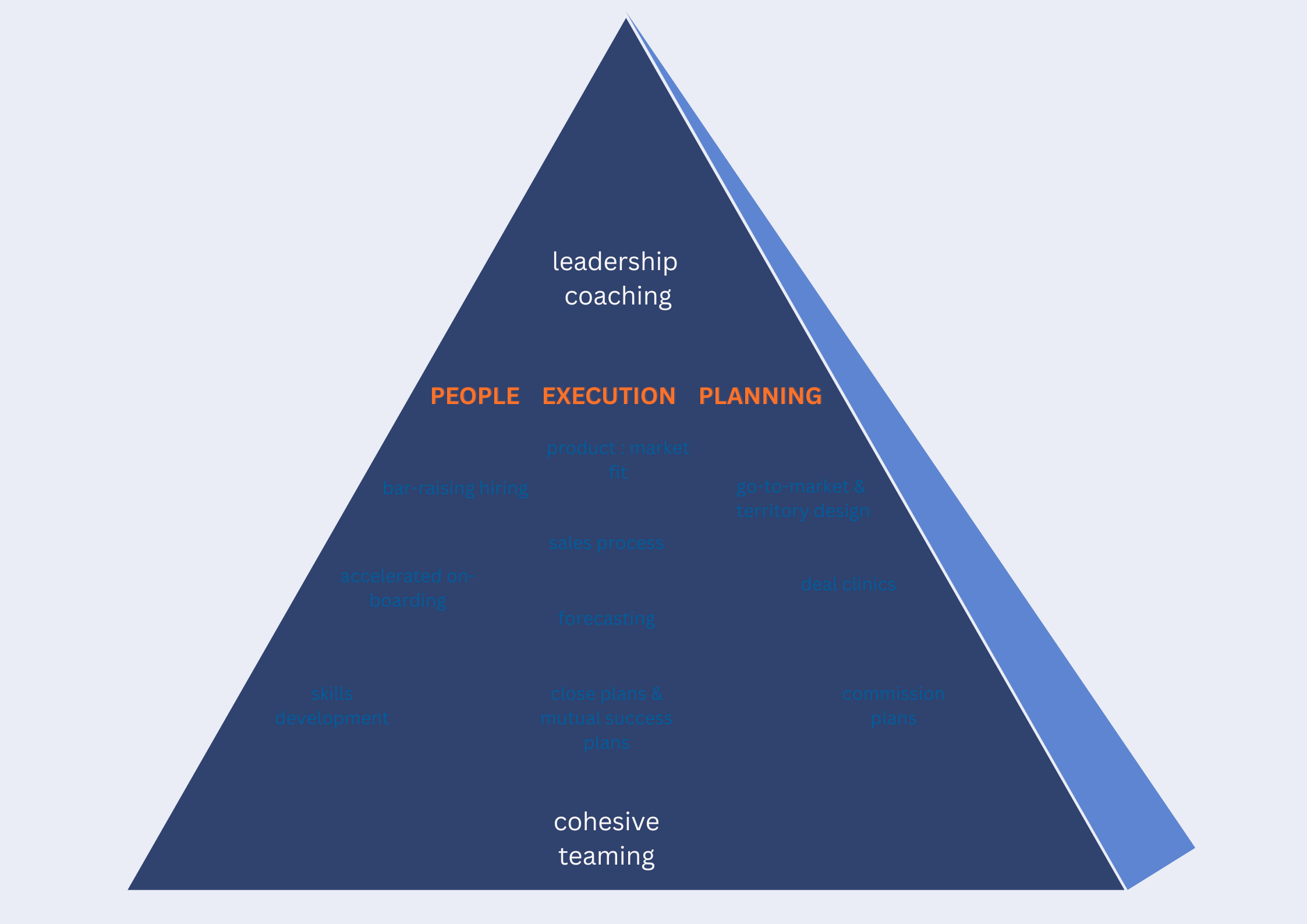
leadership coaching &
cohesive teaming
Leadership coaching
Problem
Founders often install processes but fail to get their people to use them effectively.
Leaders default to managing things, rather than leading people.
Solution
We coach founders and leaders to lead their people through the modules, not just install them.
The goal isn’t dependency on us. It’s self-sufficient leaders who can embed and sustain the practices.
The modules matter, but leadership is what makes them work.
Cohesive teaming
Problem
Teams operate in silos - development, delivery, sales, marketing, product, and customer success all pulling in different directions.
Collaboration depends on personalities, not a shared framework.
Solution
We create environments where cross-functional collaboration is systematic, not accidental.
Using Gallup CliftonStrengths, we help people understand their own strengths and, crucially, the relative strengths of their colleagues.
This builds respect, improves handoffs, and accelerates problem-solving across functions.
No one scales in isolation. Strengths-based teamwork makes the whole greater than the sum of its parts.