
We're talking energy management, not time management.
If I were to ask you to write these two sentences, it would probably take around 15 seconds.
TASK SWITCHING HAS A COST.
ATTENTION RESIDUE IS REAL.
Now, feel free to try this at home....
Write the first letter of the first sentence.
Then the first letter of the second sentence.
Then the second letter of the first sentence.
Then the second letter of the second sentence.
And keep alternating until both sentences are complete.
How long did it take?
Longer than 15 seconds, I suspect.
And probably felt a lot harder too.
The words haven't changed.
The amount of writing hasn't changed.
Why?
Because your brain isn't multitasking.
It's switching.
And every switch has a cost.
That's the hidden cost of attention residue.
When we move from one task to another, part of our attention remains attached to the previous task.
We think we've moved on.
Our brain hasn't.
Most people think productivity is about managing their time.
The highest-performing leaders I've worked with understand it's often about managing their energy.
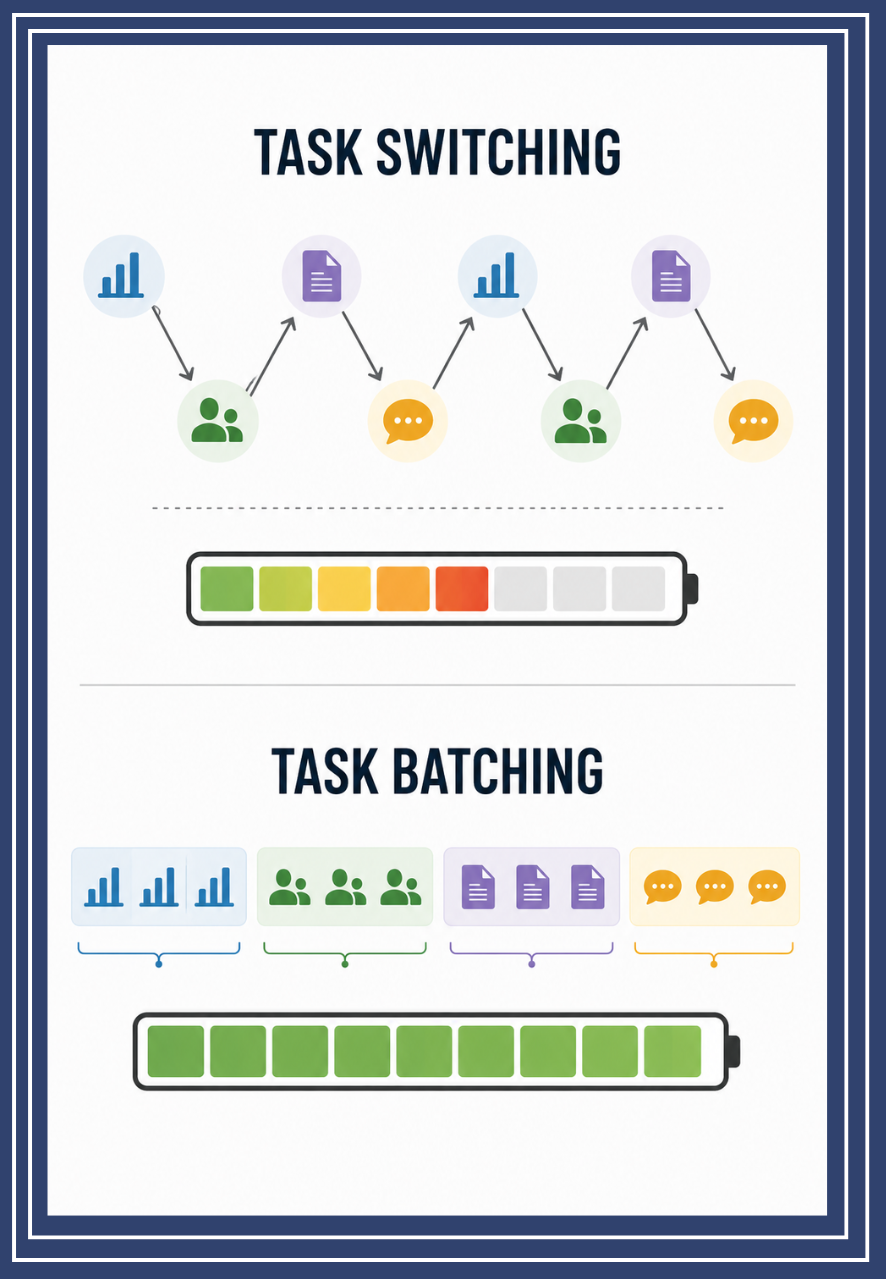
Moving from a forecast review to a customer meeting.
Then to a proposal.
Then to a 1 :1.
Then back to reporting.
Then into strategy.
The work itself isn't necessarily difficult.
The constant switching is.
Every transition forces your brain to unload one context and load another.
That's why the best executives don't just protect their time.
They protect their energy.
And one of the ways they do that is through task batching.
Customer meetings together.
One-on-ones together.
Planning together.
Reporting together.
They reduce the number of times they have to mentally change gears.
It's a bit like painting two rooms.
You can spend the day moving backwards and forwards between them, packing & unpacking as you go
Or you can finish Room A and then move to Room B.
The amount of painting is the same.
The energy required isn't.
Protect your energy, not just your time.